 |
imate
C++/CUDA Reference
|
|
imate
C++/CUDA Reference
|
An interface to CUDA linrary to facilitate working with CUDA, such as memory allocation, copy data to and from device, etc. This class contains all public static functions and serves as a namespace. More...
#include <cuda_api.h>
Static Public Member Functions | |
| static ArrayType * | alloc (const size_t array_size) |
| Allocates memory on gpu device. This function creates a pointer and returns it. | |
| static void | alloc (ArrayType *&device_array, const size_t array_size) |
| Allocates memory on gpu device. This function uses an existing given pointer. | |
| static void | alloc_bytes (void *&device_array, const size_t num_bytes) |
| Allocates memory on gpu device. This function uses an existing given pointer. | |
| static void | copy_to_device (const ArrayType *host_array, const size_t array_size, ArrayType *device_array) |
| Copies memory on host to device memory. | |
| static void | del (void *device_array) |
Deletes memory on gpu device if its pointer is not NULL, then sets the pointer to NULL. | |
| static void | set_device (int device_id) |
| Sets the current device in multi-gpu applications. | |
| static int | get_device () |
| Gets the current device in multi-gpu applications. | |
An interface to CUDA linrary to facilitate working with CUDA, such as memory allocation, copy data to and from device, etc. This class contains all public static functions and serves as a namespace.
Definition at line 35 of file cuda_api.h.
|
static |
Allocates memory on gpu device. This function uses an existing given pointer.
| [in,out] | device_array | A pointer to the device memory to be allocated |
| [in] | array_size | Size of the array to be allocated. |
Definition at line 79 of file cuda_api.cu.
References cudaMalloc().

|
static |
Allocates memory on gpu device. This function creates a pointer and returns it.
| [in] | array_size | Size of the array to be allocated. |
Definition at line 39 of file cuda_api.cu.
References cudaMalloc().
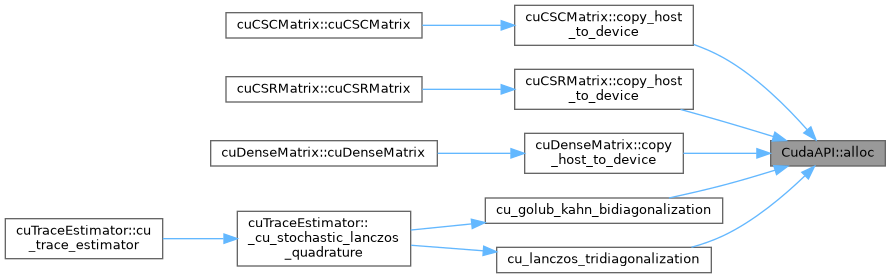
Referenced by cuCSCMatrix< DataType >::copy_host_to_device(), cuCSRMatrix< DataType >::copy_host_to_device(), cuDenseMatrix< DataType >::copy_host_to_device(), cu_golub_kahn_bidiagonalization(), and cu_lanczos_tridiagonalization().

|
static |
Allocates memory on gpu device. This function uses an existing given pointer.
| [in,out] | device_array | A pointer to the device memory to be allocated |
| [in] | num_bytes | Number of bytes of the array to be allocated. |
Definition at line 118 of file cuda_api.cu.
References cudaMalloc().
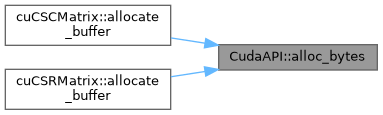
Referenced by cuCSCMatrix< DataType >::allocate_buffer(), and cuCSRMatrix< DataType >::allocate_buffer().

|
static |
Copies memory on host to device memory.
| [in] | host_array | Pointer of 1D array memory on host |
| [in] | array_size | The size of array on host. |
| [out] | device_array | Pointer to the destination memory on device. |
Definition at line 145 of file cuda_api.cu.
References cudaMemcpy().
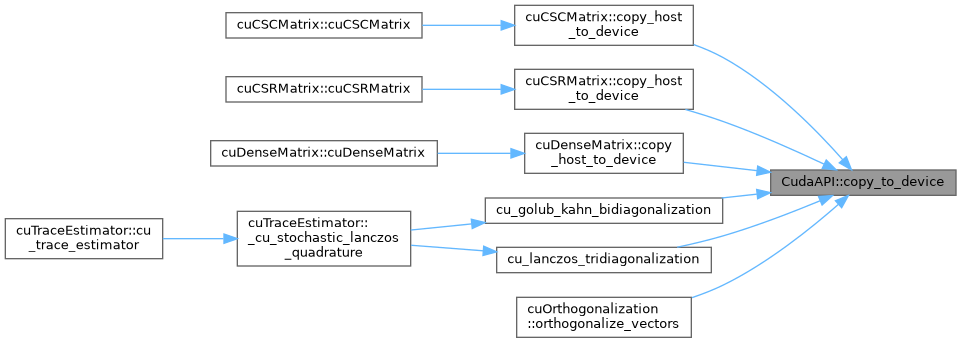
Referenced by cuCSCMatrix< DataType >::copy_host_to_device(), cuCSRMatrix< DataType >::copy_host_to_device(), cuDenseMatrix< DataType >::copy_host_to_device(), cu_golub_kahn_bidiagonalization(), cu_lanczos_tridiagonalization(), and cuOrthogonalization< DataType >::orthogonalize_vectors().

|
static |
Deletes memory on gpu device if its pointer is not NULL, then sets the pointer to NULL.
| [in,out] | device_array | A pointer to memory on device to be deleted. This pointer will be set to NULL. |
Definition at line 169 of file cuda_api.cu.
References cudaFree().
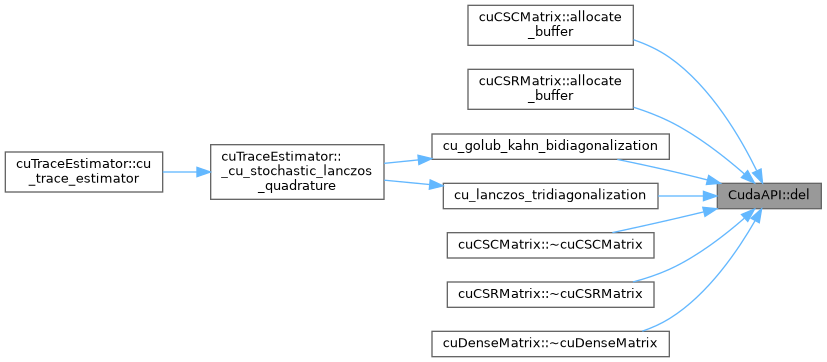
Referenced by cuCSCMatrix< DataType >::allocate_buffer(), cuCSRMatrix< DataType >::allocate_buffer(), cu_golub_kahn_bidiagonalization(), cu_lanczos_tridiagonalization(), cuCSCMatrix< DataType >::~cuCSCMatrix(), cuCSRMatrix< DataType >::~cuCSRMatrix(), and cuDenseMatrix< DataType >::~cuDenseMatrix().

|
static |
Gets the current device in multi-gpu applications.
0 to num_gpu_devices-1 Definition at line 209 of file cuda_api.cu.
References cudaGetDevice().
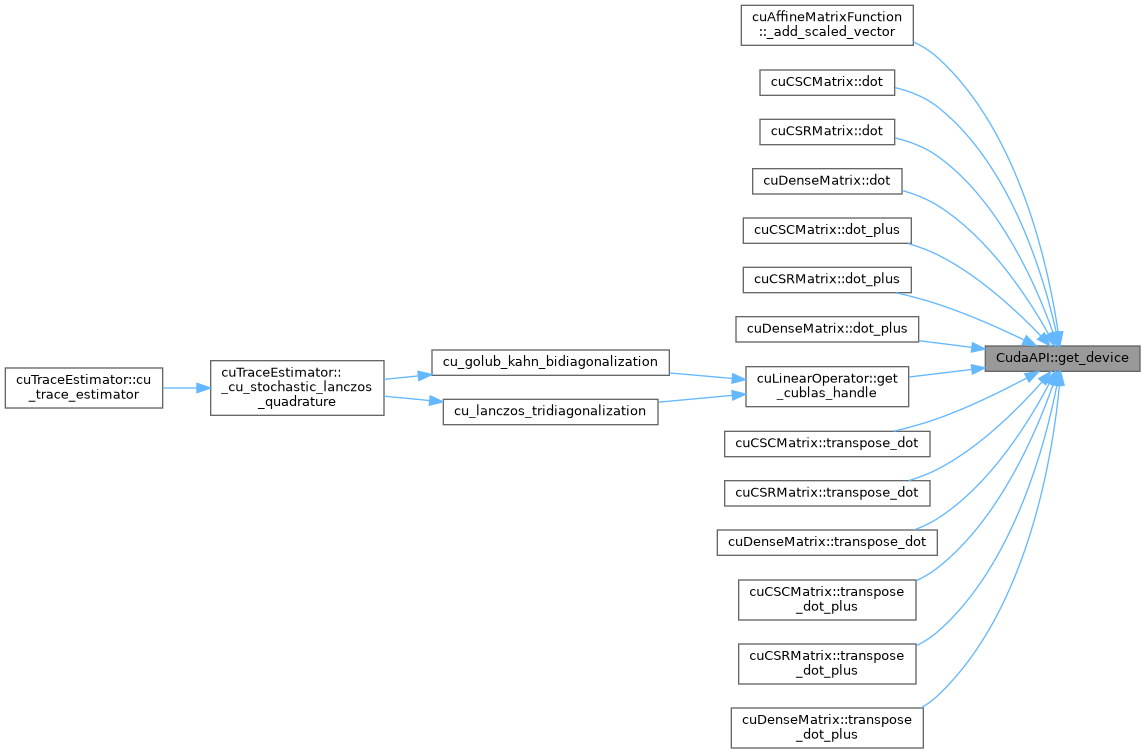
Referenced by cuAffineMatrixFunction< DataType >::_add_scaled_vector(), cuCSCMatrix< DataType >::dot(), cuCSRMatrix< DataType >::dot(), cuDenseMatrix< DataType >::dot(), cuCSCMatrix< DataType >::dot_plus(), cuCSRMatrix< DataType >::dot_plus(), cuDenseMatrix< DataType >::dot_plus(), cuLinearOperator< DataType >::get_cublas_handle(), cuCSCMatrix< DataType >::transpose_dot(), cuCSRMatrix< DataType >::transpose_dot(), cuDenseMatrix< DataType >::transpose_dot(), cuCSCMatrix< DataType >::transpose_dot_plus(), cuCSRMatrix< DataType >::transpose_dot_plus(), and cuDenseMatrix< DataType >::transpose_dot_plus().

|
static |
Sets the current device in multi-gpu applications.
| [in] | device_id | The id of the device to switch to. The id is a number from 0 to num_gpu_devices-1 |
Definition at line 191 of file cuda_api.cu.
References cudaSetDevice().
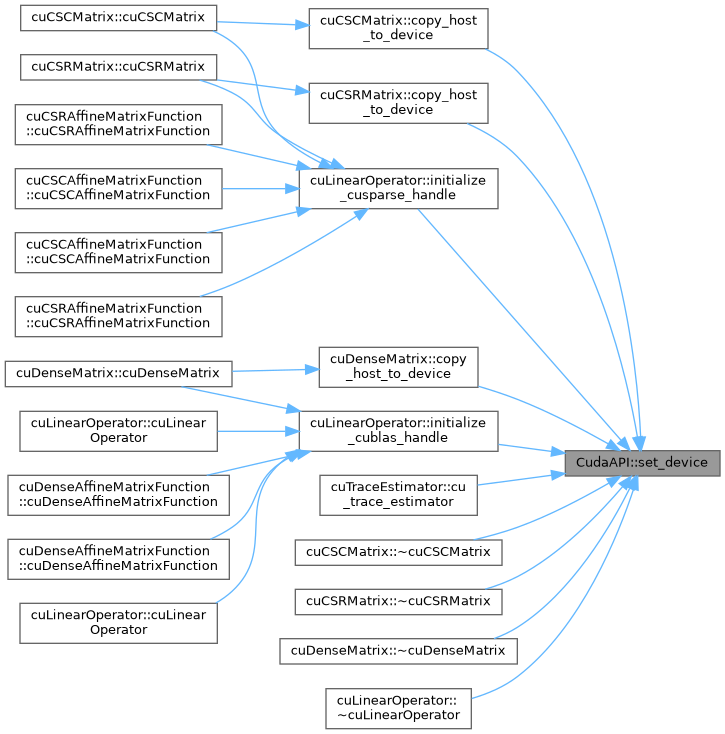
Referenced by cuCSCMatrix< DataType >::copy_host_to_device(), cuCSRMatrix< DataType >::copy_host_to_device(), cuDenseMatrix< DataType >::copy_host_to_device(), cuTraceEstimator< DataType >::cu_trace_estimator(), cuLinearOperator< DataType >::initialize_cublas_handle(), cuLinearOperator< DataType >::initialize_cusparse_handle(), cuCSCMatrix< DataType >::~cuCSCMatrix(), cuCSRMatrix< DataType >::~cuCSRMatrix(), cuDenseMatrix< DataType >::~cuDenseMatrix(), and cuLinearOperator< DataType >::~cuLinearOperator().

 1.9.8
1.9.8